Tirzepatide microdosing chart, in units.
Every chart online assumes one vial size and one water volume. Set yours below and the chart rebuilds for it — 0.5 mg through 7.5 mg, with the number to draw to on a U-100 syringe.
Why the tirzepatide chart people search for doesn't exist
"Microdosing tirzepatide chart" is one of the most-searched phrases in the whole category, and what comes back is a wall of clinic blogs that stop short of a number, because a clinic's lawyers won't let them publish one for compounded product. The pages that do give numbers assume a 10 mg vial in 2 mL and nothing else. Research-grade vials come in 5, 10, 15, 20, 30 and 60 mg, and people reconstitute with anywhere from 1 to 3 mL. That's dozens of charts. This is all of them.
The arithmetic, once
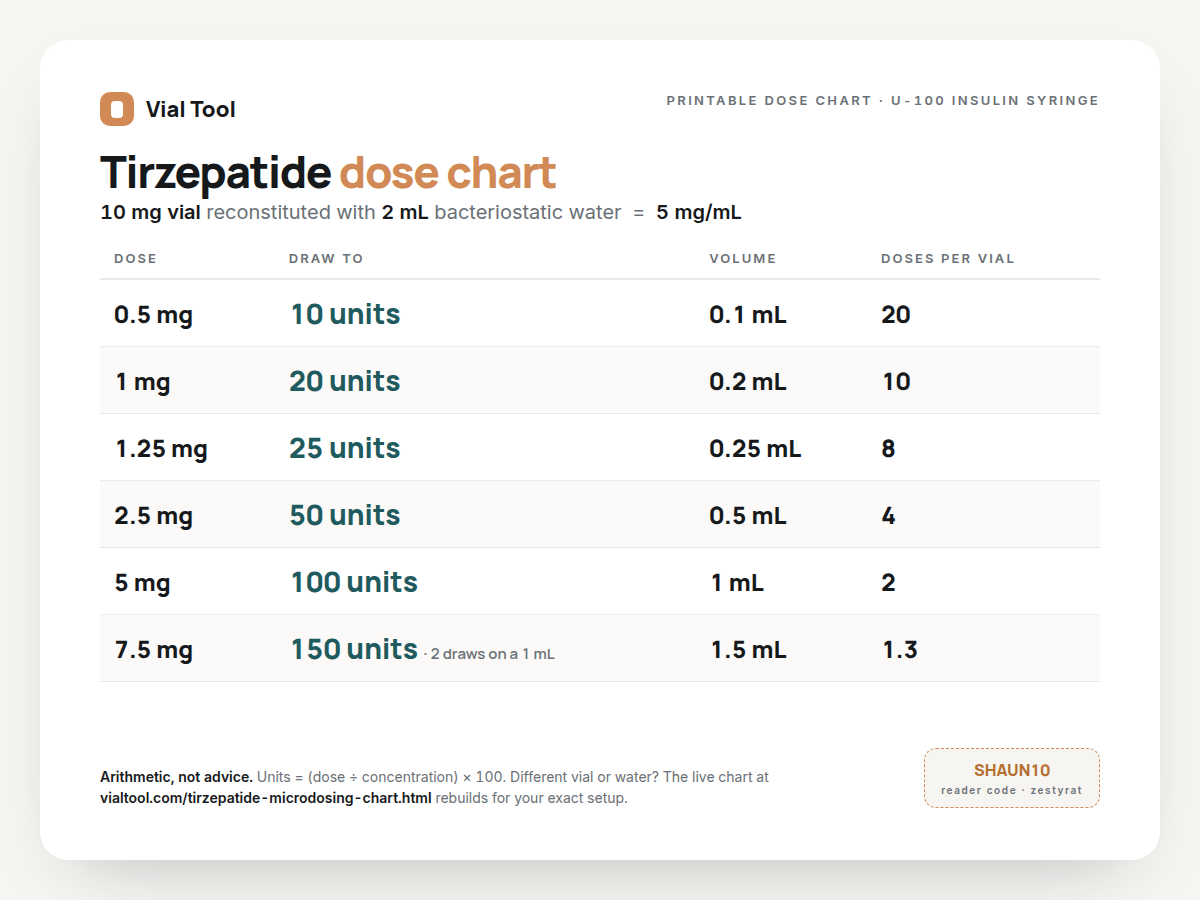
Concentration is milligrams in the vial divided by millilitres of water. A 10 mg vial with 2 mL is 5 mg/mL. Your dose divided by that concentration is the volume to draw, and volume × 100 is units on a U-100 syringe. So 2.5 mg ÷ 5 mg/mL = 0.5 mL = 50 units. 1.25 mg is 25 units. 0.5 mg is 10 units.
Common microdose ladder, 10 mg vial in 2 mL
- 0.5 mg → 10 units · 20 doses per vial
- 1.0 mg → 20 units · 10 doses
- 1.25 mg → 25 units · 8 doses
- 2.5 mg → 50 units · 4 doses
- 5 mg → 100 units (a full 1 mL syringe) · 2 doses
Notice the 1.25 mg row: 25 units lands between the 2-unit marks on a 1 mL syringe. A 0.3 mL or 0.5 mL syringe reads it exactly. The calculator will tell you this whenever it happens.
How long a vial actually lasts
At a weekly schedule, doses-per-vial is weeks-per-vial. A 10 mg vial at 2.5 mg/week is four weeks; at 1.25 mg/week it's eight. Enter what you paid and it shows cost per dose — usually the number that ends the "clinic versus research-grade" conversation.
What this page will not do
It will not tell you what dose to use, whether to microdose, or whether tirzepatide is appropriate for you. Those are clinical questions. Tirzepatide's own label carries a real warning that it can reduce the effectiveness of oral contraceptives; if that's relevant to you, that's a conversation for a prescriber, not a calculator.
Questions people actually type
How many units is 2.5 mg of tirzepatide?
From a 10 mg vial in 2 mL (5 mg/mL): 50 units. From a 10 mg vial in 1 mL (10 mg/mL): 25 units. From a 5 mg vial in 1 mL (5 mg/mL): 50 units. The concentration is what matters, not the vial size alone.
How many units is 1.25 mg of tirzepatide?
At 5 mg/mL (10 mg in 2 mL): 25 units. At 10 mg/mL: 12.5 units, which is hard to read on a 1 mL syringe — use more water or a 0.3 mL syringe.
How much water do I add to a 10 mg tirzepatide vial?
There is no single right answer; it changes only the units-per-dose, not the dose. 2 mL gives 5 mg/mL, which puts common microdoses at easy-to-read numbers (10, 20, 25, 50 units). 1 mL halves all of those.
How long does a 10 mg vial of tirzepatide last?
At 2.5 mg once a week: 4 weeks. At 1.25 mg: 8 weeks. At 5 mg: 2 weeks. Enter your schedule above and it computes it, including odd schedules.
Can I split a tirzepatide dose across two syringes?
Volume is additive, so two 25-unit draws are the same volume as one 50-unit draw. The calculator warns when a dose exceeds your syringe's capacity and suggests less water or a bigger syringe instead.