Retatrutide dose calculator, mg to units.
Retatrutide vials come in more sizes than most people expect, which is exactly when a fixed chart fails. Set yours and read the syringe.
Same math, more vial sizes
Retatrutide is sold research-grade in 5, 10, 15 and 20 mg vials. With 2 mL of water those are 2.5, 5, 7.5 and 10 mg/mL — four different unit counts for the same dose. A 2 mg draw is 80 units from a 5 mg vial in 2 mL, 40 units from a 10 mg vial, about 27 from a 15 mg vial, and 20 from a 20 mg vial. Get the vial size wrong in your head and you're off by a factor of four. That's the whole case for typing it in.
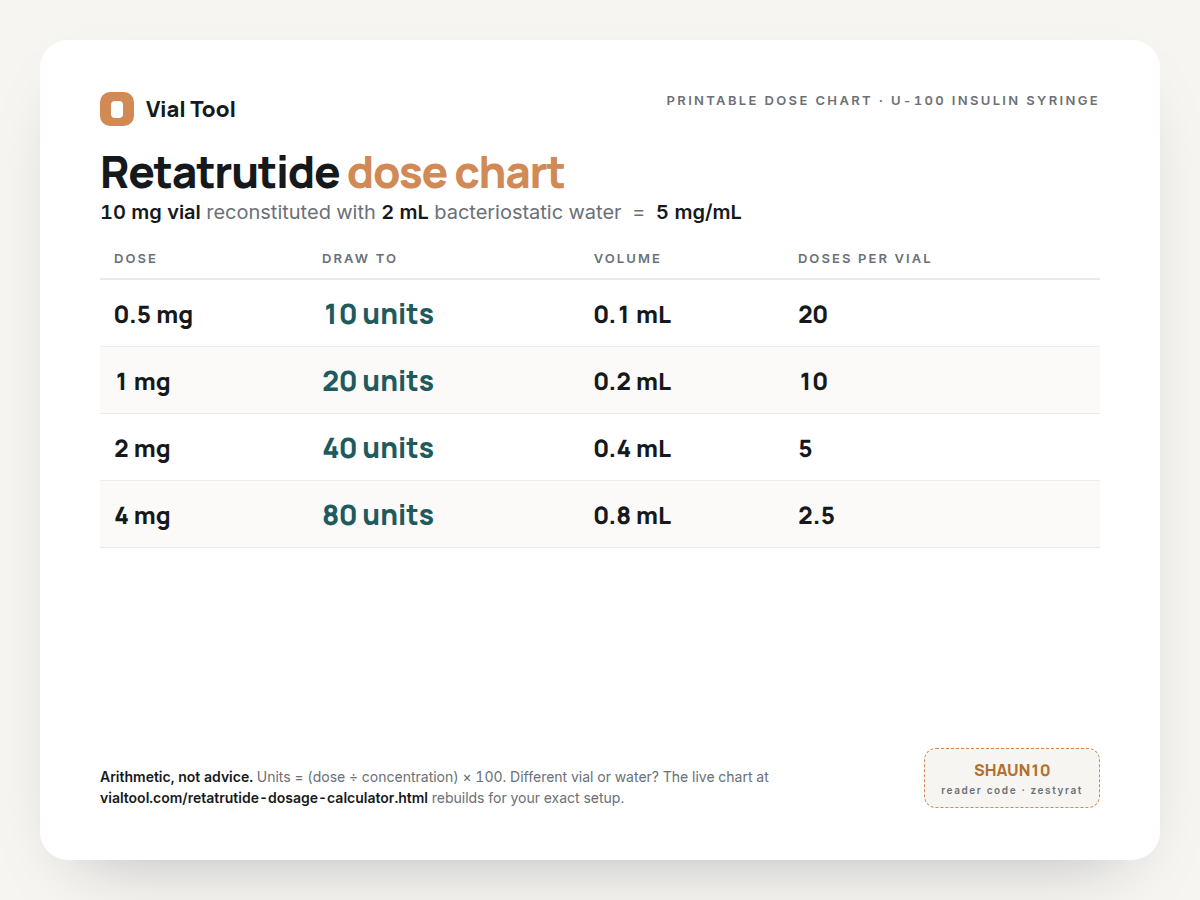
Worked example, 10 mg vial in 2 mL
- 0.5 mg → 10 units · 20 doses
- 1 mg → 20 units · 10 doses
- 2 mg → 40 units · 5 doses
- 4 mg → 80 units · 2.5 doses
About retatrutide itself
Retatrutide is an investigational compound that has not completed the approval process. Research vendors sell it as a research material. This page converts numbers for people who already have a vial and a protocol; it doesn't take a position on whether anyone should.
Questions people actually type
How many units is 2 mg of retatrutide?
From a 10 mg vial in 2 mL (5 mg/mL): 40 units. From a 20 mg vial in 2 mL (10 mg/mL): 20 units. From a 5 mg vial in 2 mL: 80 units.
How many units is 1 mg of retatrutide?
At 5 mg/mL: 20 units. At 10 mg/mL: 10 units.
How much water do I add to a 20 mg retatrutide vial?
2 mL gives 10 mg/mL, which keeps a 4 mg dose at 40 units. 1 mL doubles the concentration and halves every unit count — fine for larger doses, awkward for small ones.