GHK-Cu dose calculator, 100 mg vials included.
GHK-Cu vials are big — 50 and 100 mg — so the water volume that makes sense is bigger too. This handles the 100 mg vial that most calculators choke on.
Why "ghk-cu 100mg dosage calculator" is its own search
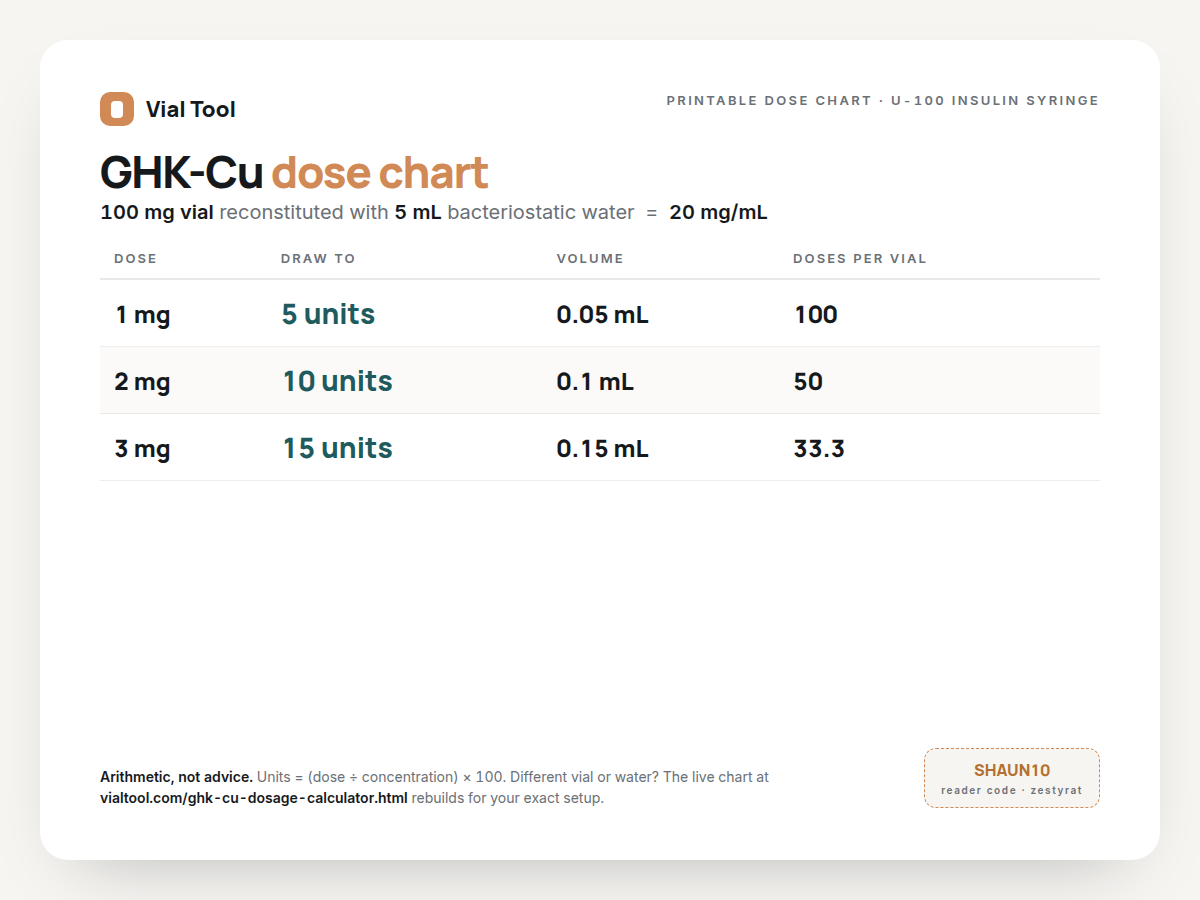
Most reconstitution calculators were built around 5 and 10 mg vials. Type 100 mg into them and the water presets are wrong, the dose presets are wrong, and the answer is a decimal nobody can draw. GHK-Cu at 100 mg with 5 mL of water is 20 mg/mL; a 2 mg draw is 0.1 mL = 10 units. With 2 mL of water it's 50 mg/mL and the same dose is 4 units — under the readable floor. More water is the answer here, and the calculator will keep telling you that until the number is sensible.
Worked example, 100 mg vial in 5 mL
- 1 mg → 5 units · 100 doses
- 2 mg → 10 units · 50 doses
- 3 mg → 15 units · 33 doses
Injectable versus topical
This page is for reconstituted, injectable GHK-Cu. Topical copper peptide serums are a different product measured in percent, not units, and no syringe math applies. Half the confusion in this search comes from the two being discussed as if they were one thing.
Storage note
A 100 mg vial at daily use is a multi-month supply. Reconstituted peptides are generally refrigerated; how long any given compound stays stable in solution is a question for the vendor's COA and storage guidance, not for a calculator.
Questions people actually type
How many units is 2 mg of GHK-Cu?
From a 100 mg vial in 5 mL (20 mg/mL): 10 units. From a 50 mg vial in 2.5 mL (also 20 mg/mL): 10 units. From a 100 mg vial in 2 mL (50 mg/mL): 4 units — too small to read well; use more water.
How much water do I add to a 100 mg GHK-Cu vial?
5 mL is a common choice: 20 mg/mL puts 1 mg at 5 units and 2 mg at 10. Small vials can't hold 5 mL; check your vial's fill line.
Is GHK-Cu injectable the same as a copper peptide serum?
No. Serums are topical, measured in percent, and have no syringe math. This page is only for reconstituted vials.